Major and total reconstruction
Patients who travel do not travel for a filling. They travel because they are missing most of their teeth, because a bridge placed twenty years ago has failed, because they cannot tolerate a denture, or because a rebuild at home was quoted at a figure they cannot meet. These are surgical cases, and they are the centre of this clinic’s work.
All-on-4 and All-on-6
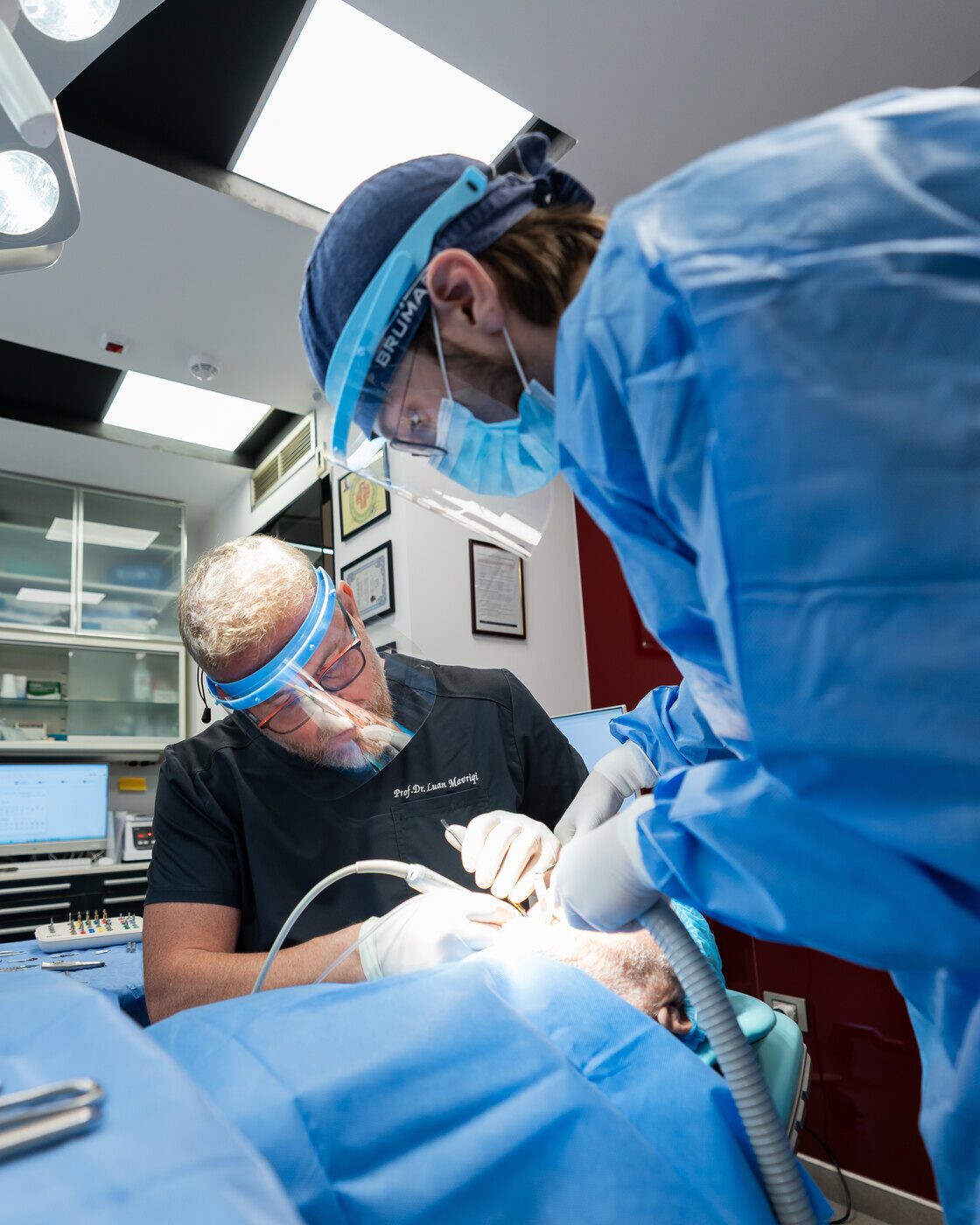
An entire arch of teeth — upper, lower, or both — supported by four or six implants placed in the areas of the jaw where bone is strongest. The implants are positioned at calculated angles so that the available bone is used instead of being rebuilt first, which is what makes the protocol possible for patients who have been told they are not candidates for implants.
What the result is
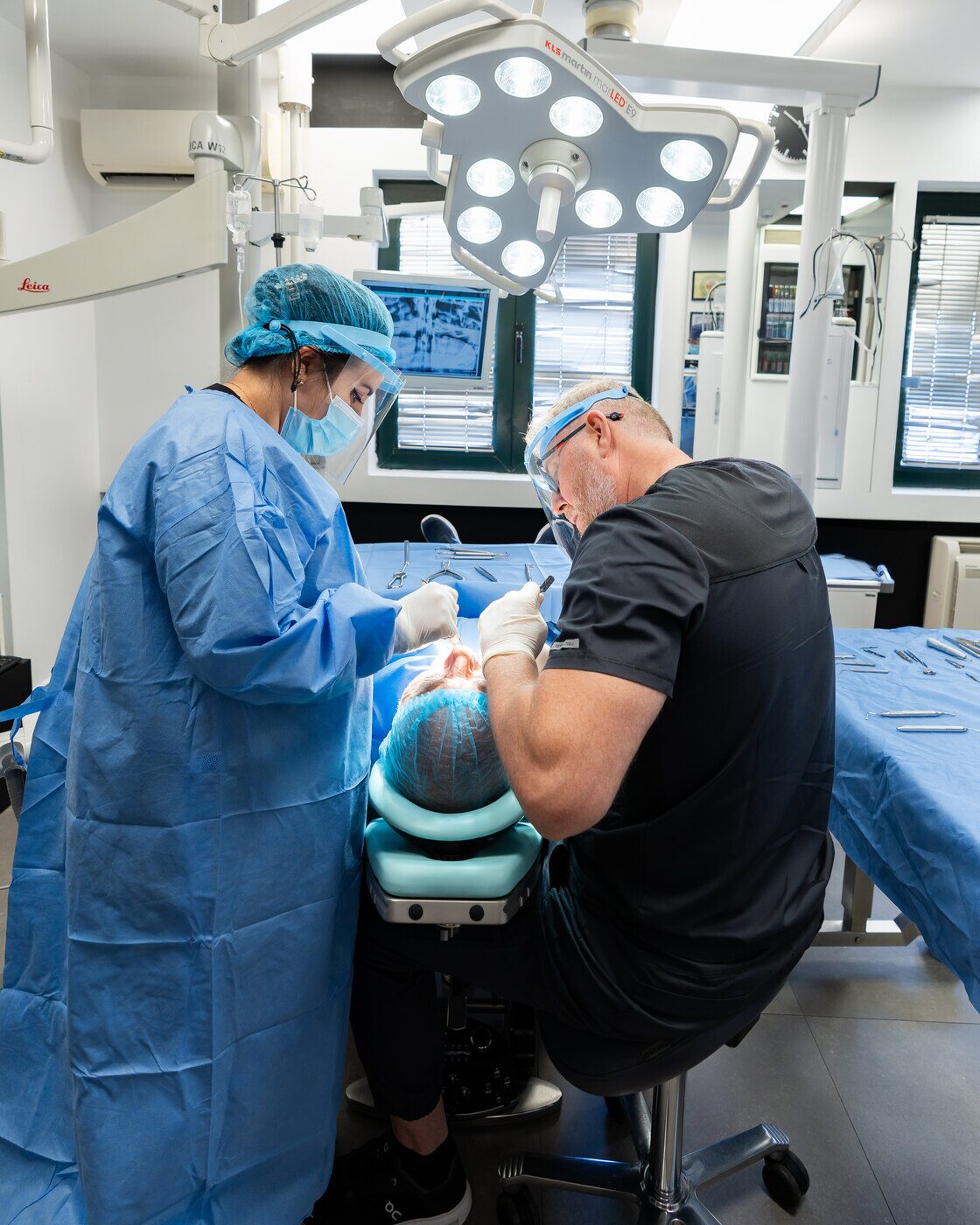
A fixed arch that is cleaned like teeth rather than taken out at night, that restores chewing function rather than approximating it, and that is designed as a face — lip support, tooth proportion, midline and smile line are decided before surgery with Digital Smile Design, and the jaw’s actual movement is recorded in 4D with MODJAW so the bite works in function and not only on a model.
Temporary teeth the same day
Where the case allows immediate loading, a temporary fixed arch is fitted in the same visit — you do not leave the clinic without teeth. Whether your case allows it depends on bone quality and the primary stability achieved at the moment of surgery, and it is confirmed at the planning stage rather than promised in advance.
Who it is for
- Patients missing all or nearly all teeth in an arch
- Patients whose remaining teeth are not worth saving — advanced periodontal disease, failed root canals, fractured or heavily restored teeth
- Long-term denture wearers who cannot tolerate a removable plate: movement, sore spots, loss of taste, and the loss of confidence when eating in company
- Patients with reduced bone volume who have been refused conventional implants elsewhere
Four implants or six?
Not a marketing choice. Six implants distribute load across a longer span and are generally preferred where bone permits, particularly in the upper jaw, where bone is softer and the sinus limits placement. Four can be entirely appropriate in the lower jaw with dense anterior bone.
The number is decided on your CBCT scan — from bone volume, bone density and the shape of the arch — and the reasoning is explained to you, in writing, before you agree to anything.
Full mouth rehabilitation
The rebuilding of a whole mouth where the problem is no longer individual teeth but the system they belong to: collapsed bite height, worn-down teeth, failed old crowns and bridges, periodontal bone loss, missing molars that have shifted everything else, and the joint or muscle pain that follows.
Who it is for
- Extensive wear from bruxism or acid erosion, where teeth have lost height and the face has shortened with them
- A mouth full of old dentistry that is now failing simultaneously
- Advanced periodontal cases where teeth are mobile and the plan must decide what is kept and what is replaced
- Combined cases: some teeth savable, some not, and implants needed in between
How the plan is built
Backwards, from the intended result. The final teeth are designed first — position, height, proportion, function — and only then is it decided which implants, which prosthetics and which surgery are needed to deliver them. The surgeon, the prosthodontist and the laboratory technician agree the target before the first implant is placed.
That is the difference between a rehabilitation and a sequence of repairs.
Cases of this size are staged deliberately: diagnosis and stabilisation, surgery, a healing period, then the definitive prosthesis. Anyone offering a full mouth rebuild finished in three days is describing a schedule, not a protocol.
Multiple implants and complex surgical cases
A large part of what arrives here has already been refused somewhere else. The reasons are usually anatomical, and they are usually solvable — but they require a structure that can operate, not only restore.
“There is not enough bone”
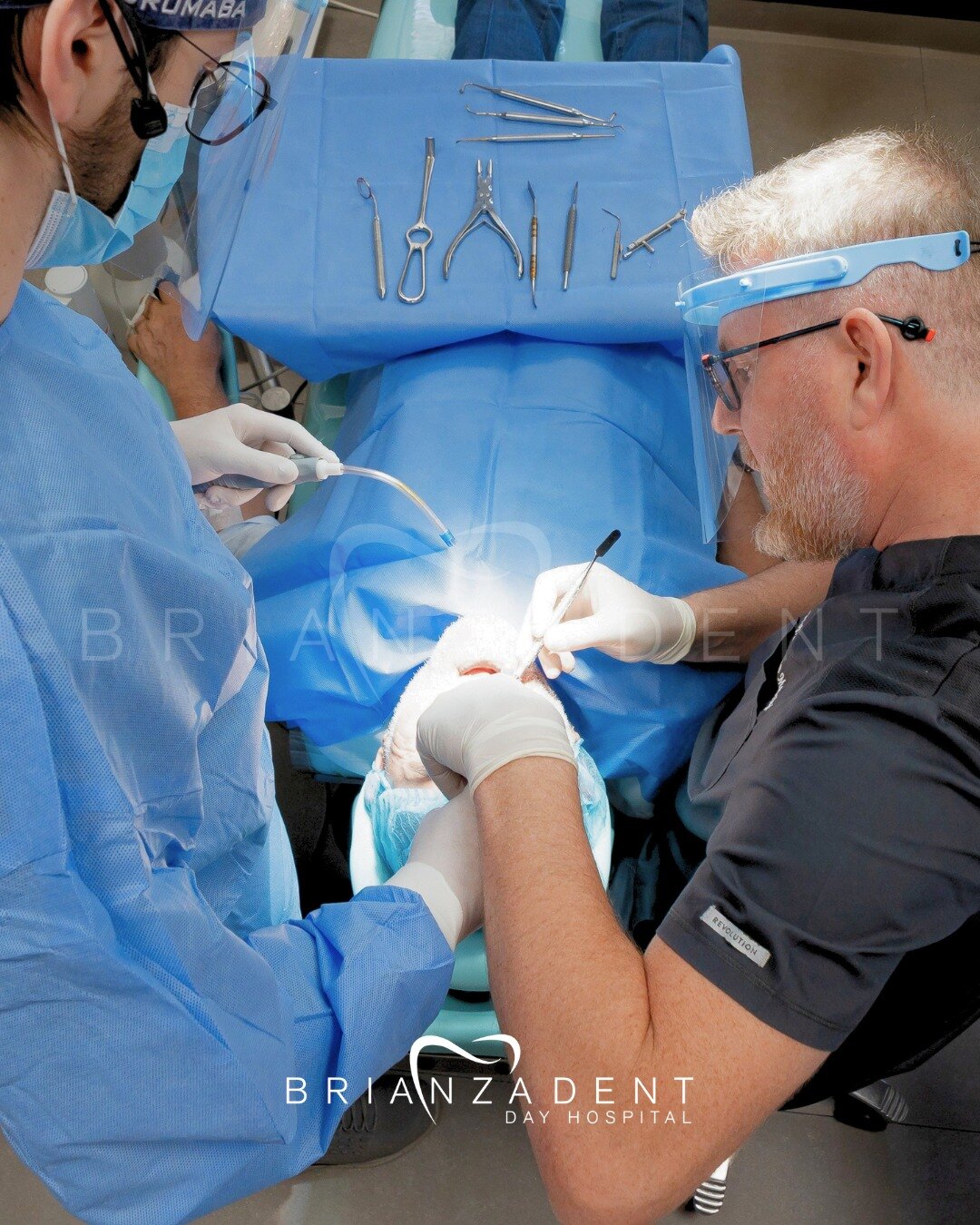
A description of the current situation, not a verdict — and often reached from a panoramic X-ray alone, which cannot show bone volume in three dimensions. Bone can be restored or bypassed: guided bone regeneration, bone substitutes in post-extraction sites, sinus lift for the upper jaw, sandwich osteotomy of the atrophic posterior mandible, and angulated placement that uses the bone that is there.
Prof. Dr. Mavriqi is a co-author of peer-reviewed studies on several of these techniques. There are cases where grafting genuinely is not the right answer, and we say so — but a refusal based on a 2D image deserves a second opinion.
-
Anatomy close to the nerve or the sinus
In the posterior mandible the inferior alveolar nerve limits implant length; in the posterior maxilla the sinus floor does the same. Both are managed with planning rather than optimism: the 3D scan establishes the safe corridor and the robotic system holds the drill to it. Where the nerve itself must be dealt with, nerve mobilisation with piezosurgery followed by immediate implant insertion is a technique the surgical team has published on.
-
Failed previous implants and failing old work
Implants that did not integrate, peri-implantitis, fractured components, bridges that have loosened over years: these cases begin with removal and reassessment, not with placing something new alongside the problem. The plan states what is being removed, why it failed as far as that can be established, and what is done differently.
-
Medically compromised patients
Diabetes, cardiovascular conditions, anticoagulant therapy and other chronic disease are assessed rather than automatically excluded. Because the clinic is licensed as a Day Hospital, relevant markers are checked in its own biochemical laboratory before surgery and re-checked afterwards, and treatment is coordinated with your own physician where required. You are told which protocol applies before you travel.
Ask for the documentation before you book
Request the QK-CSA accreditation and Day Hospital licence documents together with your free assessment.
Total transformation
For many patients the objective is not only function. It is the photograph they avoid, the hand in front of the mouth, the years of choosing what to eat in company. A total reconstruction combines the surgical and the aesthetic sides of the case into a single design — and the whole result is decided visually before any tooth is prepared.
-
Digital Smile Design
The smile is designed on your own face and images, using the protocol developed by Dr. Christian Coachman, so proportion, midline and smile line are decisions rather than outcomes.
-
MODJAW 4D recording
Your jaw movement is captured live and shown to you on a 21-inch screen, so the design is tested against how you actually chew.
-
Digital surgical planning
Implants are positioned to serve that design, not the other way round — then executed under robotic guidance.
-
In-house production
The restorations are made in the clinic’s own laboratory, so refinements happen the same day instead of the following week.
What is achievable in your case depends on your anatomy, bone, soft tissue and general health, and is established after examination and imaging. We show you what the plan is designed to achieve; we do not promise a specific outcome before we have seen your scan.
Total transformations only
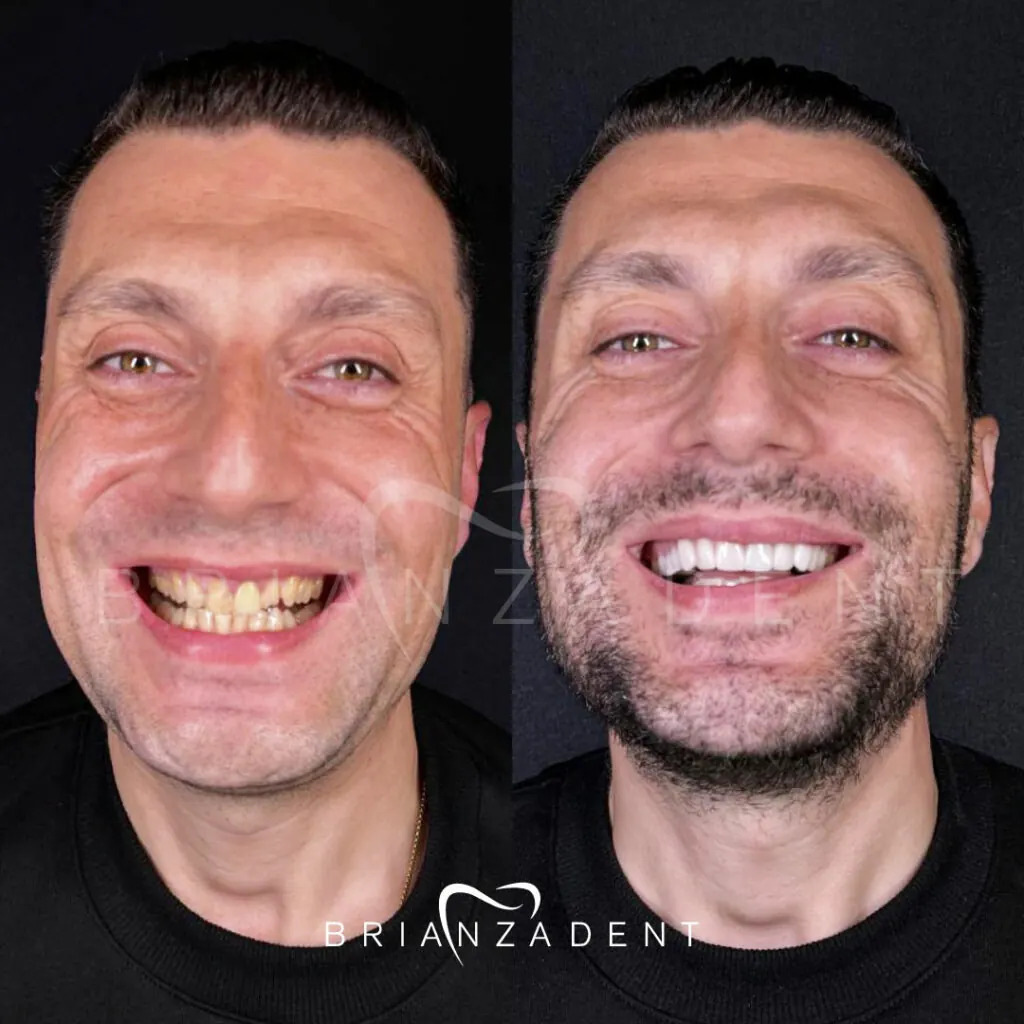
Every case in this section started from an arch that could not be saved — teeth broken down to the gum, missing, or gone entirely — and finished with a fixed full arch on implants.
Each was completed at Brianza Day Hospital and is published with the patient’s written consent. Ask specifically to be shown cases comparable to yours rather than the best cases on the site: what matters is whether a case started where yours is now, not how good the finished photograph looks.
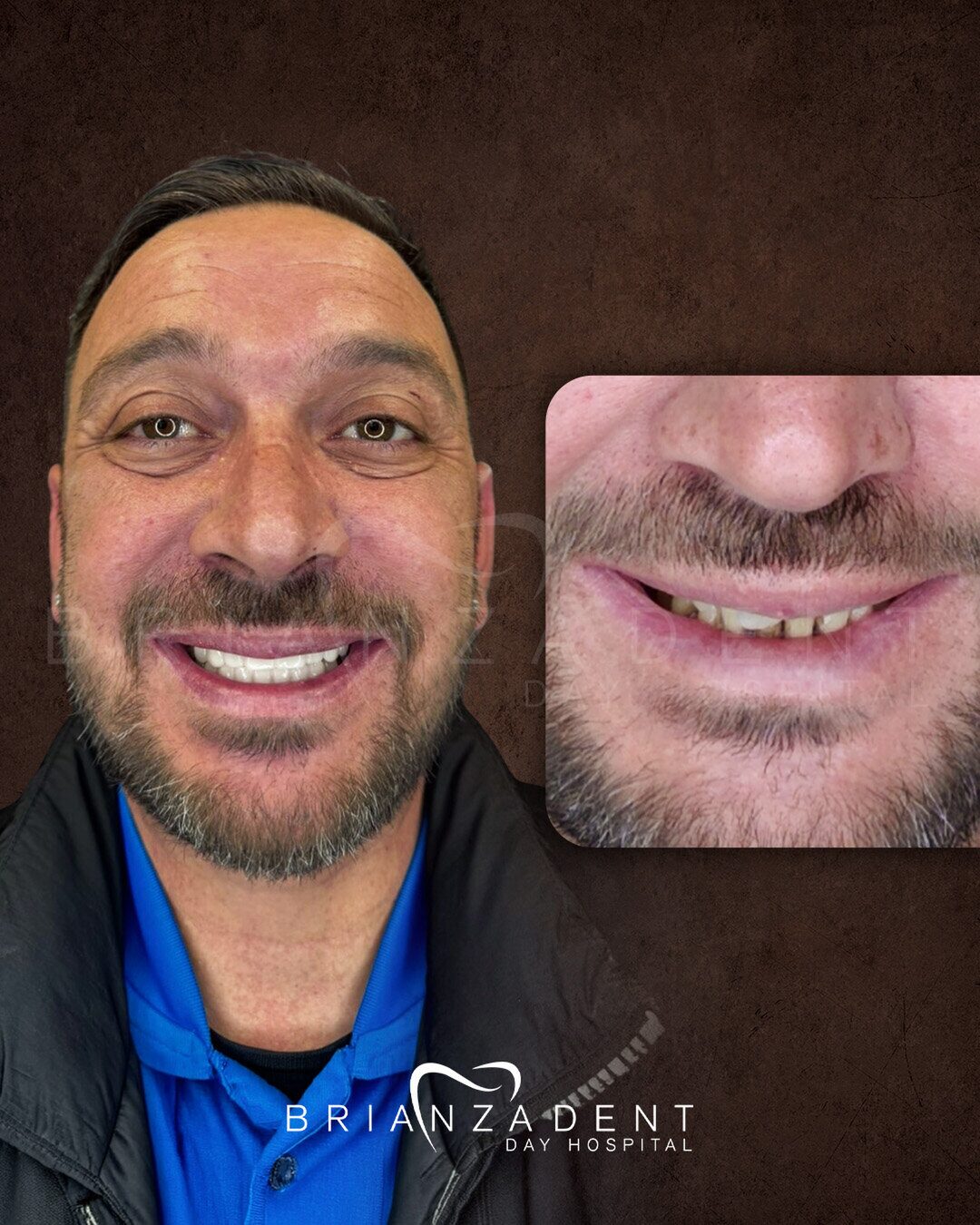
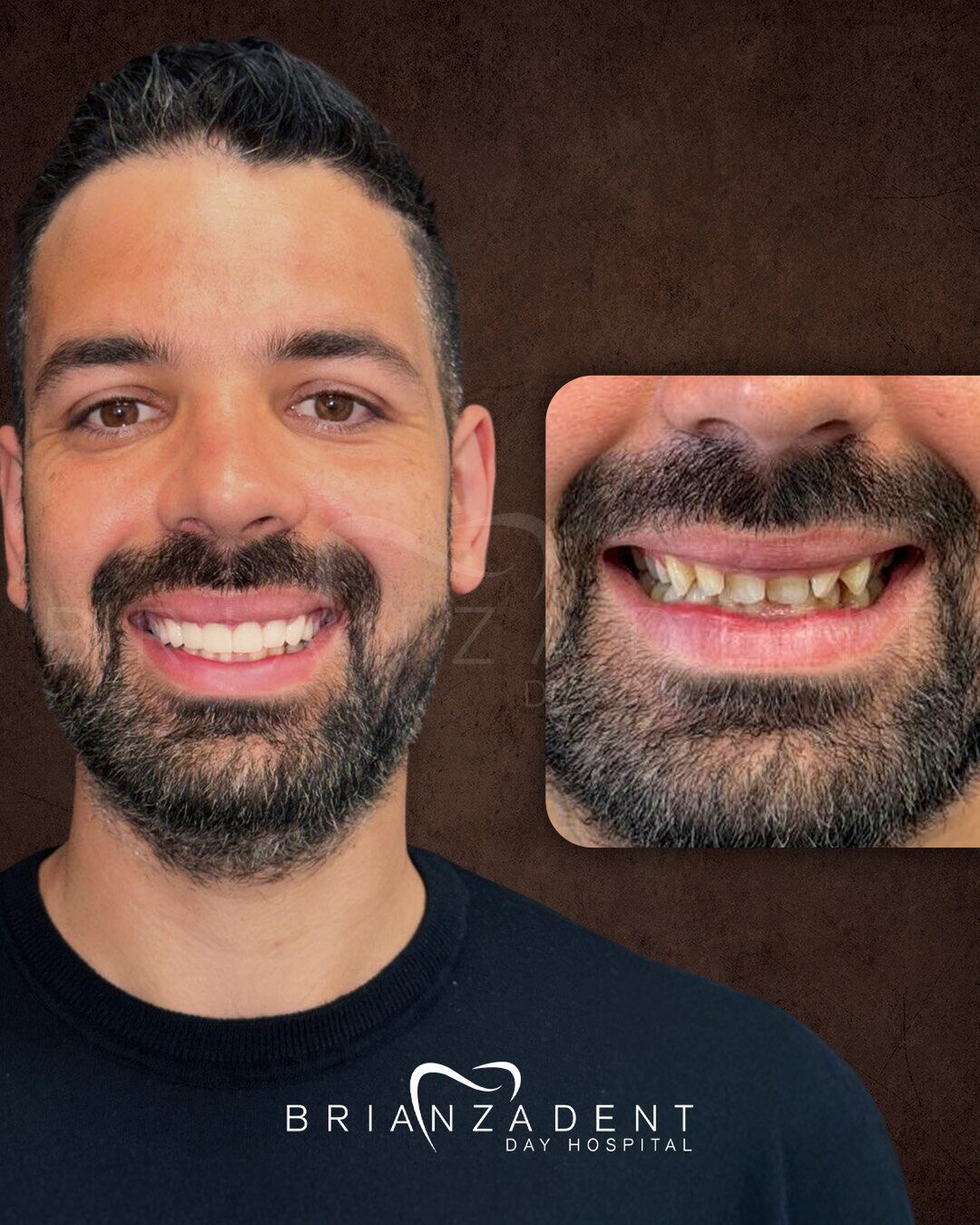
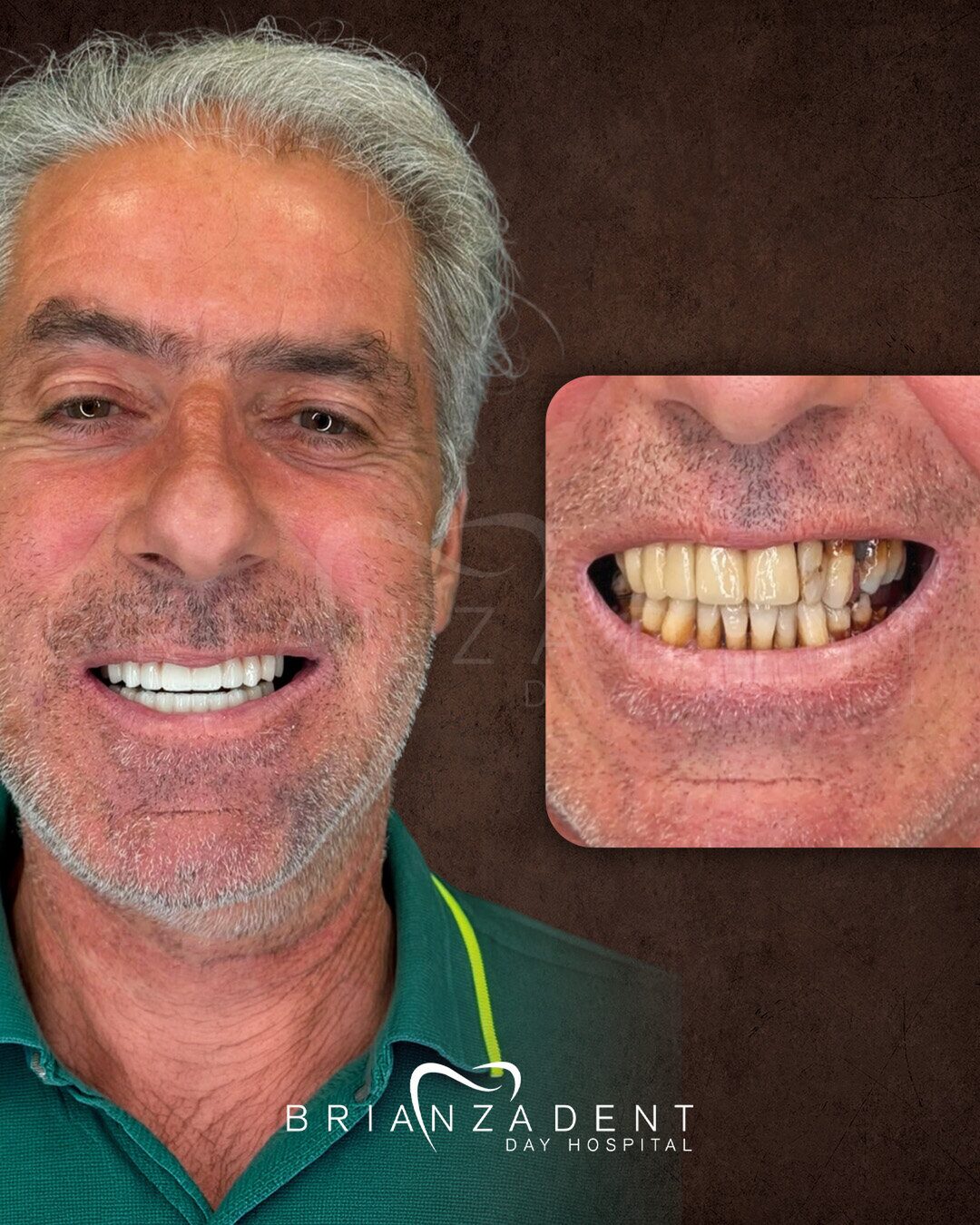
Results shown are individual cases. What is achievable in your case depends on your own anatomy, bone, soft tissue and general health, and can only be established after examination and imaging.
Could your case look like these?
Send a panoramic X-ray and photographs. The surgical team reads the imaging and replies with a written assessment of what is treatable, which protocol fits your anatomy, and how many days it would take.
- A panoramic X-ray — or a CBCT scan if you already have one
- Photographs of your smile, front and side
- A short description of your situation and medical history
No charge and no obligation for the initial review. Enquiries are handled in English, Italian, Greek and Spanish. Prefer to talk? +355 68 418 5084 · Message us on WhatsApp
Large cases fail for boring reasons
A plan that was not prosthetically driven. An implant placed in the wrong axis. A laboratory that was three weeks away. A complication no one was equipped to manage. A patient who should have been assessed medically and was not. Everything below exists to remove one of those.
- An accredited hospital-grade setting — QK-CSA accreditation and a Day Hospital licence, so long surgical sessions happen under audited protocols with monitored recovery.
- An anaesthesiologist on the team — a full-arch case completed in one planned session instead of split across visits you have to fly back for.
- A biochemical laboratory in the building — pre-operative blood work processed on site, results the same day, no lost travel days.
- Surgery and prosthetics under one roof — grafting, sinus lift and nerve-related surgery performed in house.
- An in-house dental laboratory — the technician is in the same building as the surgeon and the patient; adjustments to a full arch are made the same day.
- Robotically guided placement — precision matters more, not less, as the number of implants rises; a multi-implant arch has to be accurate as a set.
- Verification, not assumption — multi-implant impressions are recorded with PIC Dental, accurate to 4 microns and supported by more than 18 peer-reviewed studies.
- Continuity since 1998 — cases restored many years ago are still followed here, which is the only meaningful evidence in implantology.
What patients ask first
I have been told I need all my teeth removed. Can I really leave with fixed teeth instead of a denture?
In many cases yes — that is what a full-arch implant rehabilitation is for. An entire arch is supported by four or six implants placed where the bone is strongest, and the teeth are screwed onto them: fixed, cleaned like teeth, removable only by a clinician. Where the case allows immediate loading, a temporary fixed arch is fitted in the same visit. Whether your case allows that depends on bone quality and the stability achieved at the moment of surgery, and it is confirmed at the planning stage — not promised in advance.
All-on-4 or All-on-6 — which one will I need, and is six better?
It is decided on your CBCT scan, not from a price list. Six implants distribute load across a longer span and are generally preferred where bone permits, particularly in the upper jaw, where bone is softer and the maxillary sinus limits placement. Four can be entirely appropriate in the lower jaw, where the anterior bone is dense. You receive the reasoning in writing, with the scan, before you agree to anything.
I have been told there is not enough bone for implants. Is my case hopeless?
“There is not enough bone” describes your current situation; it is not a permanent verdict, and it is often reached from a panoramic X-ray alone, which cannot show bone volume in three dimensions. A CBCT scan frequently changes the assessment. Where bone genuinely is insufficient, it can be rebuilt or bypassed. Send your imaging and we will review it free of charge.
How many days and how many trips does a full arch take?
Two trips, in most cases. The first covers the 3D scan, blood work, surgery and — where the case allows immediate loading — the temporary fixed arch. The second, after a healing period of roughly three to six months, is for the definitive arch. Be sceptical of anyone offering a complete rebuild in three days — that is a timetable, not a protocol.
How much does a full arch cost?
We will not quote a figure before seeing imaging, because a number given without it is not a price. What moves the total: the number and position of implants, whether grafting or a sinus lift is needed, immediate versus delayed loading, the temporary arch, the prosthetic material chosen, sedation or general anaesthesia, the condition of your remaining teeth, and the number of visits. Send a panoramic X-ray and you receive a written plan with each of these named and priced separately.
Send your panoramic X-ray
The surgical team reviews your imaging and replies with a written assessment: what is treatable, which protocol is realistic for your anatomy, and how many days it would take.